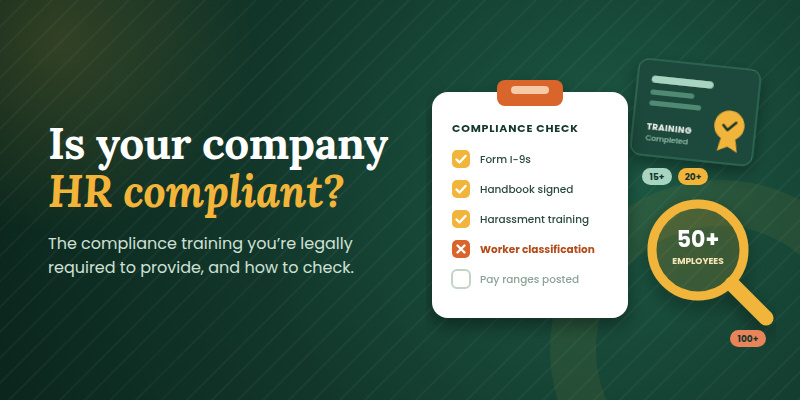
Most business owners find out they’re not HR compliant the hard way: a former employee’s complaint, a state labor department letter, or an audit that surfaces a gap nobody knew existed. By then, it’s not a compliance question anymore, it’s a legal one.
HR compliance is a specific, checkable set of federal, state, and local requirements that change depending on your headcount, your location, and your industry.
This guide walks through what “HR compliant” actually means, the clearest signs a company is falling short, the employee-count thresholds that quietly add new obligations as you grow, and how to get a real answer in about two minutes using EasyLlama’s free Compliance Grader instead of guessing.
What “HR Compliant” Actually Means
HR compliance means your company is meeting every employment law that currently applies to it, not just the ones you happen to know about. That includes federal laws like the Fair Labor Standards Act (FLSA), Title VII of the Civil Rights Act, and OSHA’s workplace safety rules, plus whatever state and local laws apply based on where your employees and job candidates are actually located.
This is exactly why HR compliance is hard to self-assess. It isn’t one fixed checklist. A 12-person company in Ohio and a 12-person company in California are operating under meaningfully different rulebooks, and a company that hires its 51st employee, or opens an office in a new state, can trigger new obligations overnight without anyone flipping a switch.
The Core Categories of HR Compliance
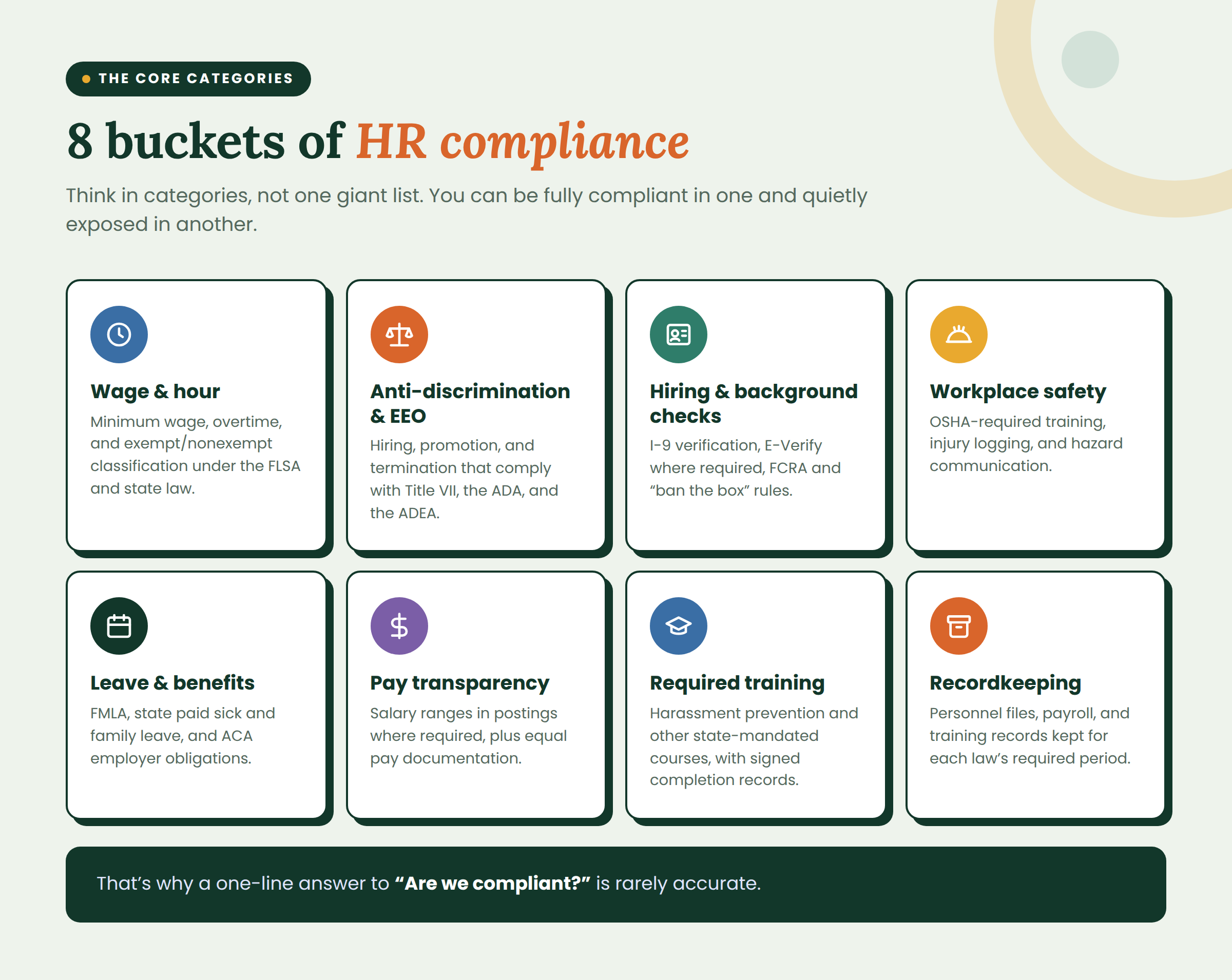
Most HR compliance obligations fall into a handful of recurring categories, and it helps to think in these buckets rather than as one giant undifferentiated list:
- Wage and hour: minimum wage, overtime, and correct exempt/nonexempt classification under the FLSA and state law
- Anti-discrimination and EEO: hiring, promotion, and termination practices that comply with Title VII, the ADA, and the ADEA, and similar laws
- Hiring and background checks: I-9 verification, E-Verify where required, and background check practices that follow the Fair Credit Reporting Act and state “ban the box” rules
- Workplace safety: OSHA-required training, injury logging, and hazard communication
- Leave and benefits: FMLA, state paid sick and family leave laws, and ACA employer obligations where they apply
- Pay and hiring transparency: salary range disclosure where state law requires it, and equal pay documentation
- Required training: harassment prevention and other state-mandated courses, tracked with signed completion records
- Recordkeeping: retaining personnel files, payroll records, and training documentation for the periods each law requires
A company can be fully compliant in one category and quietly exposed in another, which is why a one-line answer to “are we compliant” is rarely accurate.
You Know You’re Compliant When You Can Prove It
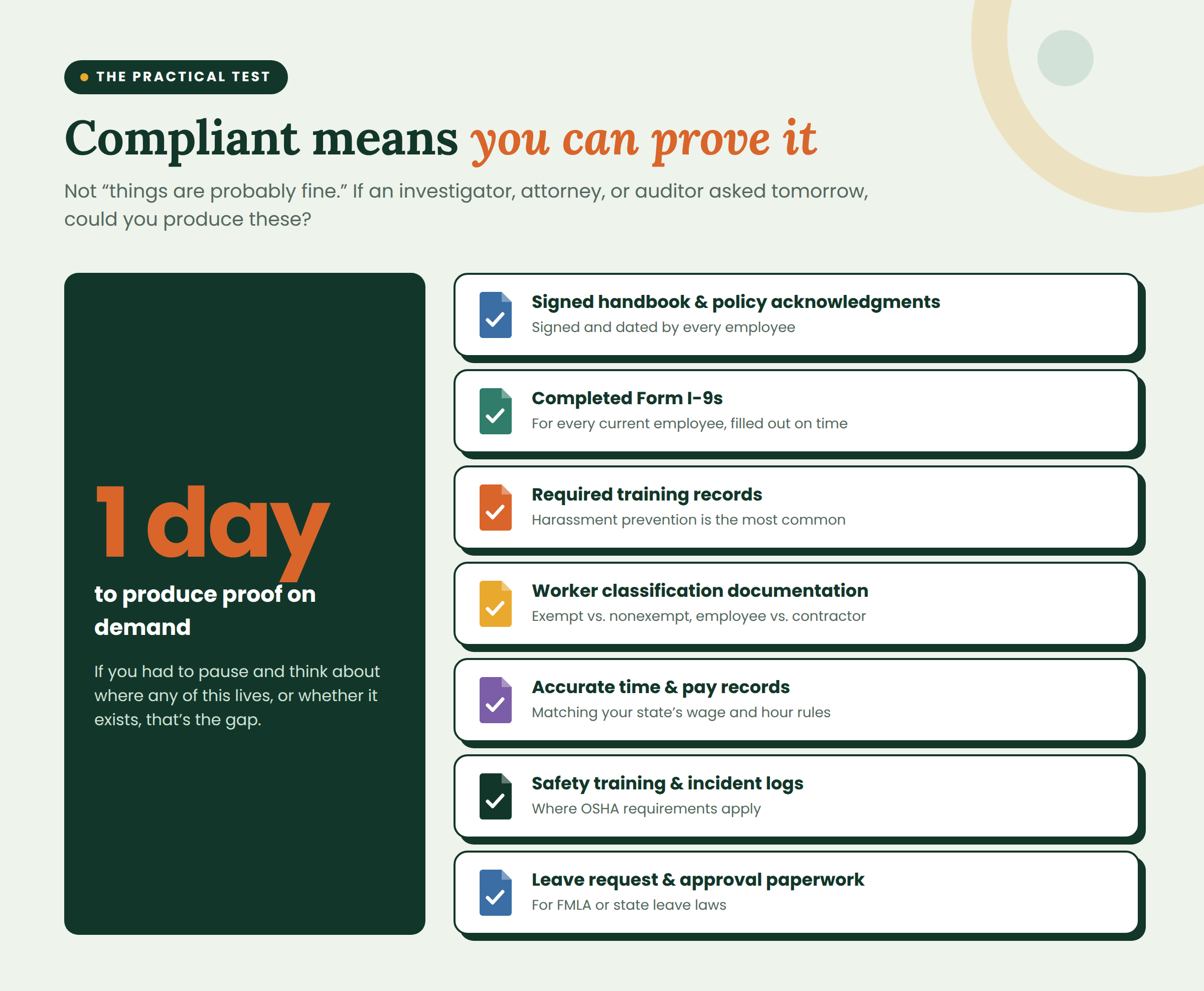
Here’s the honest, practical test: you are HR compliant when you can produce documentation on demand, not when you feel like things are probably fine. If a state investigator, an employee’s attorney, or an auditor asked for proof tomorrow, could your company produce it within a day? That typically means:
- Signed, dated acknowledgments for your employee handbook and key policies
- Completed I-9 forms for every current employee, filled out on time
- Training completion records for anything legally required in your state (harassment prevention is the most common)
- Documentation showing how each role was classified as exempt or nonexempt, and as an employee or independent contractor
- Accurate time and pay records that match your state’s wage and hour rules
- Safety training and incident logs where OSHA requirements apply
- Leave request and approval paperwork for FMLA or state leave laws
If you had to pause and think about where any of that lives, or whether it exists at all, that’s the gap. Plenty of companies with no active complaints and no lawsuits are still sitting on compliance gaps, they simply haven’t been tested yet.
7 Signs Your Company Might Not Be HR Compliant
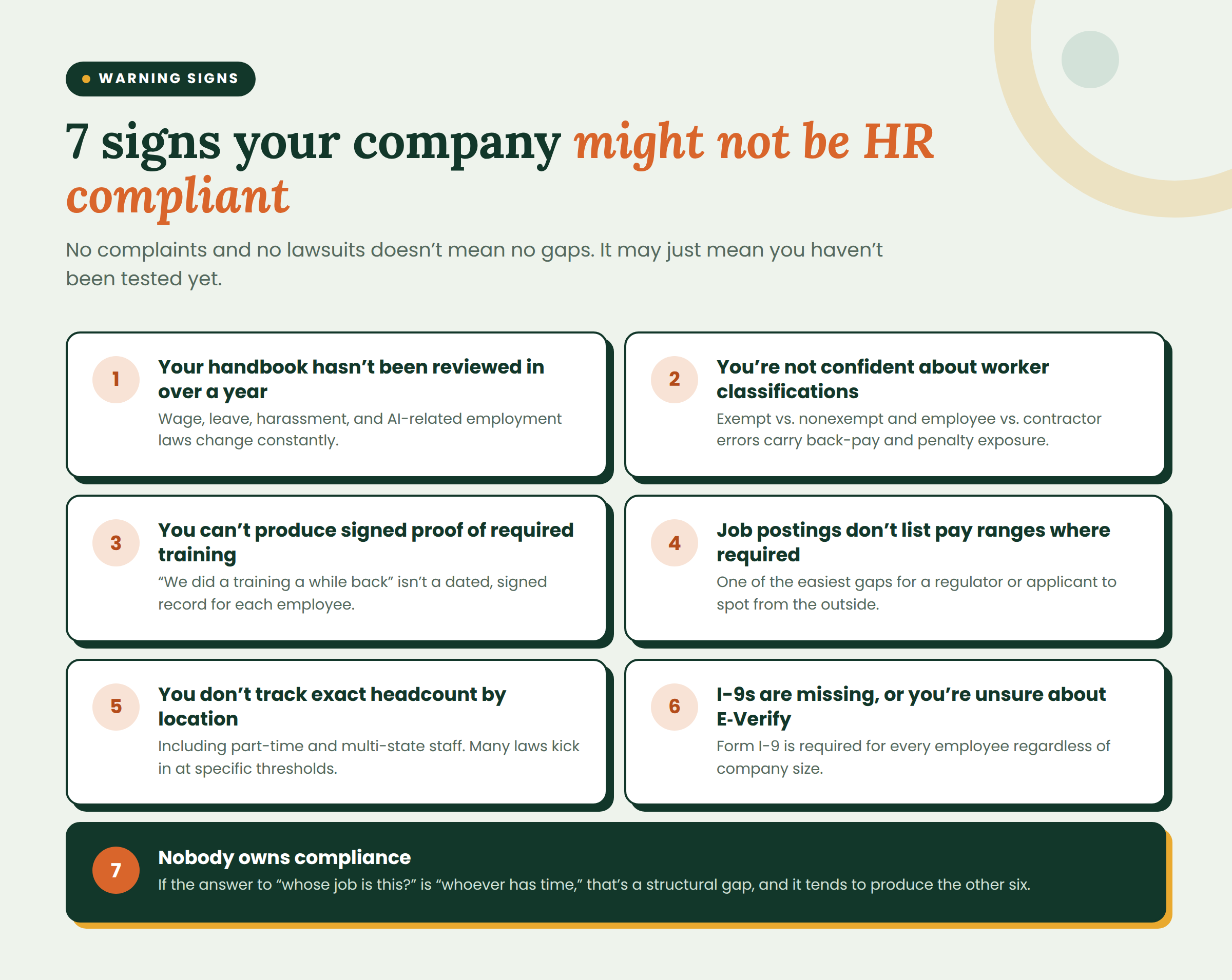
Your employee handbook hasn’t been reviewed in over a year. Wage, leave, harassment, and AI-related employment laws change constantly. A handbook written two or three years ago is very likely missing current requirements.
You’re not confident about worker classifications. Exempt versus nonexempt and employee versus independent contractor are two of the most commonly misapplied classifications, and both carry back-pay and penalty exposure when they’re wrong.
You can’t produce signed proof of required training. Several states require documented, recurring harassment prevention training. “We did a training a while back” is not the same as a dated, signed completion record for each employee.
Your job postings don’t list pay ranges where the law requires it. A growing list of states now require salary ranges in job postings, and this is one of the easiest gaps for a regulator or an applicant to spot from the outside.
You don’t track your exact headcount by location. Because so many obligations kick in at specific employee-count thresholds, not knowing your real number, including part-time and multi-state staff, means you don’t actually know which laws apply to you right now.
I-9s are missing, incomplete, or you’re not sure if E-Verify applies. Form I-9 is required for every employee in the country regardless of company size, and several states additionally mandate E-Verify for some or all employers.
Nobody owns compliance. If the honest answer to “whose job is this” is “whoever has time,” that’s a structural gap, not a documentation one, and it tends to produce all the other six.
The Employee-Count Thresholds Most Companies Don’t Track
A large share of HR compliance is triggered automatically by headcount. Crossing these numbers adds legal obligations whether or not your HR processes have caught up:
| Employee count | Laws that apply |
| 1 or more | Fair Labor Standards Act (minimum wage, overtime), OSHA general duties, Equal Pay Act, Form I-9 verification, and other baseline federal laws |
| 15 or more | Title VII, ADA, PDA, GINA |
| 20 or more | Age Discrimination in Employment Act (ADEA), COBRA continuation coverage |
| 50 or more | Family and Medical Leave Act (within 75 miles), ACA employer shared-responsibility mandate |
| 100 or more | Annual EEO-1 pay and demographic reporting*, WARN Act notice requirements for large layoffs or closures |
*EEO-1 reporting is still required as of this writing, but the EEOC published a proposed rule on July 23, 2026 to eliminate EEO-1 through EEO-6 reporting entirely; its public comment period closed August 24, 2026 and no final rule has been issued yet.
None of these thresholds care whether you noticed you crossed them. If your company has grown, opened a new location, or brought on more contractors this year, it’s worth recounting against this list specifically.
The State-by-State Layer Most Companies Miss
Meeting every federal requirement on the list above still isn’t the whole picture because states and cities layer on their own rules. Two examples show how much this varies:
Harassment prevention training is currently mandated, not just recommended, in states including California (5 or more employees), Connecticut (3 or more), Delaware (50 or more), Illinois (all employers, annually), Maine (15 or more), and New York (all employers, annually), along with city-level rules in New York City, Chicago, and Washington, D.C. A handful of other states recommend training without requiring it. If your company operates in more than one of these places, “we did a training” isn’t a complete answer, the requirement, the frequency, and who has to be trained all vary by jurisdiction.
Pay transparency laws requiring salary ranges in job postings are now in effect in at least ten states, including California, Colorado, Connecticut, Hawaii, Illinois, Maryland, Nevada, New York, Rhode Island, and Washington, with more states considering similar bills. Illinois’s law is one of the more recent additions, applying to employers with 15 or more employees. This list has grown steadily and is worth rechecking regularly rather than assuming it’s settled.
How to Actually Check, Instead of Guessing
If you want a real answer to “are we HR compliant” rather than a hopeful one, work through this in order:
- Count your employees accurately, by location, including full-time, part-time, and long-term contractors, and compare that number against the thresholds above.
- Pull the last 12 months of required training records and confirm you have a signed, dated completion record for every employee who needed one.
- Audit your worker classifications, starting with anyone paid a flat salary who might not actually qualify as exempt, and anyone treated as a 1099 contractor who works set hours under your direction.
- Check your live job postings against the pay transparency law in every state where you’re hiring.
- Confirm every current employee has a complete, on-time Form I-9 on file, and check whether E-Verify applies to you in your state.
- Review your employee handbook against this year’s law changes, not the year it was originally written.
- Or skip the manual audit and run your company through the EasyLlama Compliance Grader, which does steps one through six for you in about two minutes.
Where EasyLlama’s Compliance Grader Fits In
This entire article is really one question: how do you know if your company is HR compliant? The honest answer for most businesses is that you can’t know for certain without checking against your specific industry, location, and headcount, and most leaders don’t have time to research all of that by hand.
That’s exactly the gap the Compliance Grader was built to close. It’s a free tool, no credit card required, that asks a few quick questions about your business and returns a personalized report in about two minutes. Instead of a generic checklist, you get a report of which compliance laws currently apply to you by industry, location, and role, which training is legally required versus simply recommended, and precisely where your risk gaps are, so you know exactly what to fix and in what order.
Where a generic HR compliance checklist tells you everything that could apply to any company, the Compliance Grader tells you what actually applies to yours, which is the only version of that answer that’s actually useful.
What Happens If You Find Out You’re Not Compliant
Finding a gap is not the same as being in trouble. Most compliance issues are fixable, and finding them proactively, before a complaint or audit, is the best-case version of this problem. A few practical points:
Prioritize by risk, not by ease. Wage and hour misclassification and missing safety training carry the highest legal and financial exposure, so start there even if a handbook update feels more urgent.
Fix forward before fixing backward. Getting current practices compliant matters more immediately than perfectly reconstructing old records, though you should still document what you find and what you corrected.
Don’t try to fix everything in one week. A rushed, undocumented scramble can create its own inconsistencies. A short remediation plan with owners and dates is more defensible than an overnight overhaul.
Keep a record of the fix itself. Documentation showing you identified a gap and corrected it typically counts in your favor if a regulator or attorney ever asks about it later.
Building an Ongoing Compliance Habit, Not a One-Time Fix
HR compliance isn’t a project with an end date because the laws underneath it keep changing and your headcount keeps moving. The companies that stay out of trouble tend to treat this as a recurring habit rather than a one-time cleanup: rerunning a compliance check every time headcount changes meaningfully or a new state gets added, refreshing required training on the legally mandated schedule rather than “whenever we get to it,” and assigning clear ownership so compliance isn’t quietly nobody’s job.
Frequently Asked Questions
Q: How do you know if your company is HR compliant?
A: You know your company is HR compliant when you can produce current documentation, such as signed policy acknowledgments, completed I-9s, required training records, and accurate wage and classification records, for every legal requirement that applies to your specific headcount, industry, and locations. A quick way to check is running your business through a tool like the Compliance Grader rather than assuming based on how things feel.
Q: What happens if a company is not HR compliant?
A: Consequences depend on the specific law involved, but can include back pay, civil penalties, and lawsuits for wage and hour or discrimination violations, and fines for missing required training or improper I-9 documentation. Reputational and turnover costs often outlast the direct legal penalty.
Q: How many employees before certain HR laws apply?
A: Key federal thresholds include 15 or more employees for Title VII and the ADA, 20 or more for the ADEA and COBRA, 50 or more for the FMLA and the ACA’s employer mandate, and 100 or more for EEO-1 reporting and the WARN Act. Some laws, including the FLSA and OSHA, apply from your first employee. Note that EEO-1 reporting itself is currently the subject of a proposed EEOC rule that would eliminate it, so check its status before treating it as settled.
Q: Do small businesses need to be HR compliant?
A: Yes. Several major requirements, including the FLSA, OSHA’s safety obligations, and Form I-9 verification, apply to employers of any size. Small businesses are not exempt, they simply face a shorter list of additional laws than larger companies do.
Q: How often should a company run an HR compliance check?
A: At minimum, once a year, and again any time your headcount crosses a new threshold, you open in a new state, or a law you’re subject to changes. Required training also typically needs to be refreshed on its own legally mandated schedule.
Q: Is HR compliance the same in every state?
A: No. Federal law sets a floor, but many states and cities add their own requirements, such as mandatory harassment prevention training or pay transparency in job postings, and those obligations vary significantly by location.
Q: What’s the difference between HR compliance and HR best practices?
A: HR compliance refers to what the law legally requires. HR best practices are recommended approaches that go beyond the legal minimum, such as more generous leave policies or more frequent training, that companies choose to adopt for culture or retention reasons rather than because a law demands it.
Q: What documents do I need to be HR compliant?
A: At minimum, a current employee handbook with signed acknowledgments, completed I-9 forms for every employee, records of any legally required training, documentation supporting each worker’s classification, and wage and hour records that match your state’s requirements. Exactly which documents matter most depends on your headcount, industry, and locations.
The Bottom Line
“How do you know if your company is HR compliant” isn’t a question you should have to guess at, and it isn’t one you want to answer for the first time during an investigation. The honest answer is that compliance is specific to your headcount, industry, and locations, and it changes as all three of those things change.
Run your organization through the free EasyLlama Compliance Grader to get a real, personalized answer in about two minutes, then use what it surfaces to build the training and documentation habits that keep the answer “yes” going forward.